

High Effort, Low Reward
An honest look at one of my least favorite pastimes

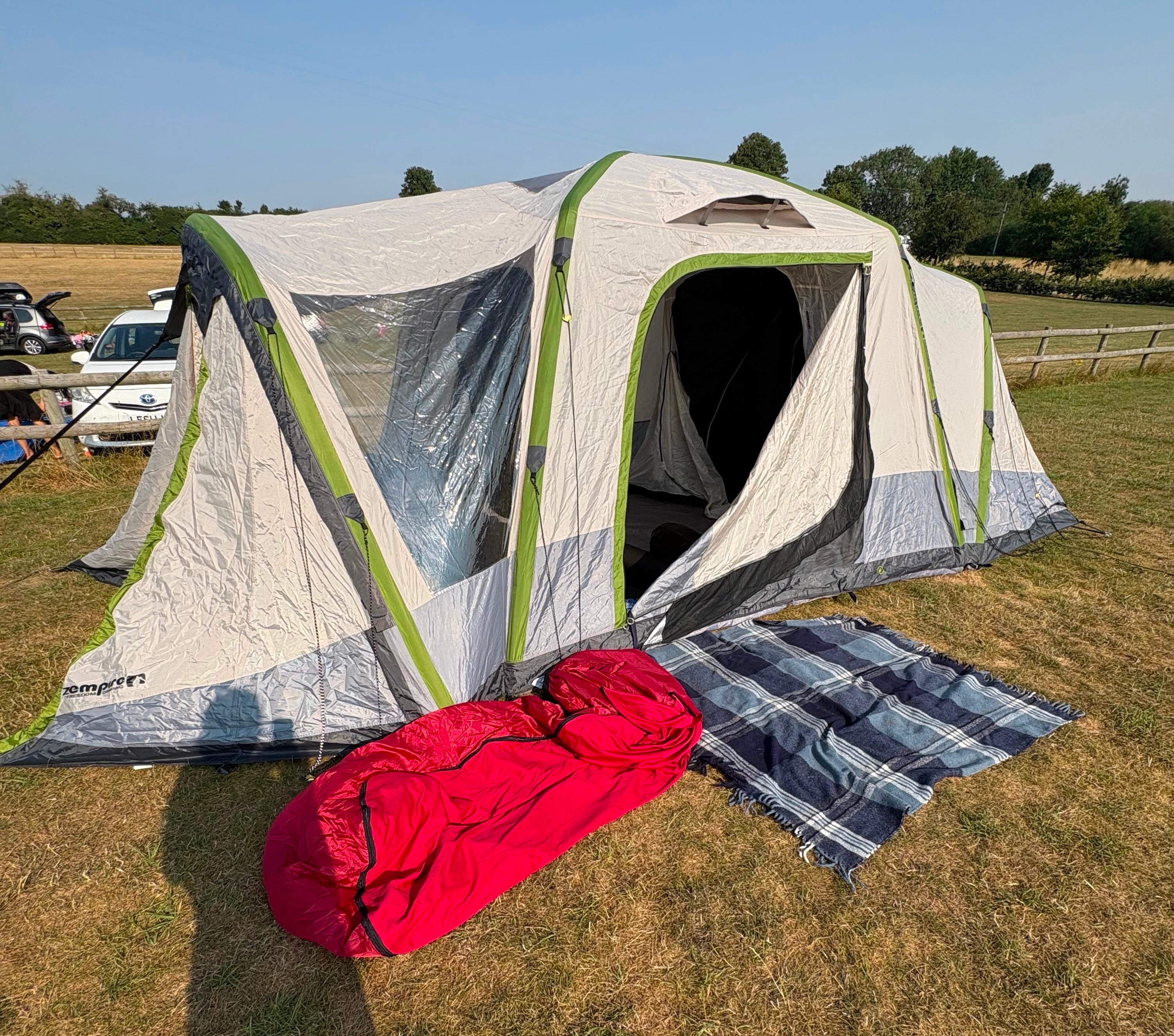
I’ve always had a complicated relationship with camping. I try to be a good sport about it. I’ve even gone so far as to try to convince myself that I do enjoy it. But it’s almost like the camping trips themselves are trying to send me a message.
Take the one time, when camping in Australia, when I woke in the night to find a possum staring at me and at such close quarters I could clearly make out its beady, milky white-green eyes. I jostled my husband awake. He sleepily assured me that it was outside of the tent, separated from us by the thin, transparent mesh. “No worries,” he said in his calm, reassuring Aussie way. “Go back to sleep.” He then rolled over, at which point I heard the sound of the creature’s paws on the tent floor. Chaos ensued. Tell me this: have you ever had the pleasure of smelling possum pee?
Or another family excursion, this time in Wales, when we arrived at our camping site to find that there were two options: a space on the nice flat section that had to be reserved in advance for 10 pounds, or a space on a massive incline. I turned to my husband. “Please God,” I said. “Tell me you paid.”
He hadn’t paid.
We set up camp on the hill. In the night, I woke up to use the toilet and peeked at my kids. There was my daughter and, beside her, our beloved dog, who was flat on his back, looking very cozy. But where was my son? I panicked. He was a sleepwalker at the time. Had he walked into the darkness? I woke my husband again. He told me not to worry, but thankfully got up to help me look. We tramped around, sweeping our head torches across the campground. Then, we spotted him. He’d rolled out of the tent, through the open fly and down the incredibly steep hill, all while managing to stay asleep. My husband picked him up, still in his sleeping bag, and said, “See? He’s fine.”
I have, mostly, kept my feelings about camping to myself. I never want to be a killjoy, and there are some aspects of camping I appreciate—sitting around the campfire, swapping stories, spending time in nature. Why wasn’t that enough?
Recently, when speaking with Professor and researcher Michael Inzlicht about effort and reward, Michael shared the following story with me:
“I ruined camping for myself,” he said. “I didn’t grow up going camping. My parents are immigrants—they think camping is the weirdest thing ever—but being a good Canadian, I started going, and I loved it. And at first.
Then I wrote this paper called The Effort Paradox, and…I started thinking. My last big camping trip in Canada—it’s portaging with canoes, you’re out in the wild, you don’t see people for, like, days, and I realized… Do I really like camping?
Before the camping trip, I’m anxious and nervous. During the camping trip, I’m complaining about the bugs and the terrible food, and I can’t sleep. And then when I come home, I’m like, thank God I’m home. Maybe I don’t like camping. And it’s just all the work that fooled me into thinking this is valuable.”
I wanted to stand up from my chair and applaud. I wanted to shout it from the rooftops. I don’t like camping! And I finally understood why.
It’s not about being outdoors—I absolutely love that. It’s not about needing to be comfortable—I can stay in a shepherd’s hut, sleep on a bare wooden floor. (I actually prefer the least gear possible when camping.) And it’s not about the physical difficulty—I run marathons and enjoy putting in the effort to accomplish new things; to expand my mental and physical capacities.
It’s that this version of hard work is not valuable to me.
Michael has spent much of his career studying why and how people find meaning and rewards in different types of effort. It’s a subject I’ve become increasingly interested in as AI is changing our relationship to effort. The question, more and more, is: why put forth any unnecessary effort, especially when it comes to thinking? We have AI for that. The answer is complex but in short: effort really matters to our brain.
Effort and reward are tied to the nucleus accumbens, a small structure buried inside the brain that’s often called the ‘hub for motivation’. It’s our wanting system. Dopamine, the reward chemical, helps motivate anticipation and progress—it signals to us to keep going, that whatever we’re working on is worth pursuing. For some people, the greatest satisfaction comes during the preparation or process of work—for others it comes with the finished outcome. Either way, the brain is assessing whether the effort is worth the payoff.
I’m the type of person who gets a huge dopamine reward from the work and process of something—preparing garden beds, compiling stacks of research, the writing and rewriting of a manuscript. Upon completing the project, I get a sense of accomplishment, of course, but nothing nearly as impactful as the high I get from preparing.
Which brings me back to camping. Despite being a process person, I realize now that the effort of preparing for camping is not the type of effort I enjoy. Schlepping the tent, sleeping bags, and mats down from the loft. Finding all the gear in different places all over the house. Preparing food that won’t go off for a few days. Putting the roof rack on. My husband and children do derive pleasure from this hard work, even if the end result (the trip itself) ends up being rainy or bleak or—god forbid—involves possum pee. I simply don’t.
It doesn’t mean I won’t go camping anymore–I will. I love seeing people at their happiest around the campfire (even if we all stink afterwards). I absolutely derive joy from the joy of others. Recognising that the effort-reward relationship is different for everyone has also felt quite liberating—and made me more understanding of my family’s urge to fill our calendar with camping trips. But I’m newly inspired to double down on the hard work that makes my brain and my body hum.
Tell me, what work, hobby, or task do you regularly take on that is rewarding because it is difficult? Comment below.
About to go camping, and thanks to your article I realise its because I am an end result being there type person, and my husband is a prep person and we have divided the effort along those lines.
Haha great read! I love camping, but especially the cycling in between campsites. I guess it's something to do with the dopamine system you describe. Being on the move all day on the bike, putting in some effort on the bike, being rewarded by another nice view around every corner. And I always sleep well after a good day's cycling.