

The Courage to be Creative
Why—and how—to break free from briefs

In the heart of Warsaw, behind a pair of heavy black metal gates, on the other side of a cobbled courtyard, there’s a basement where I encountered an idea that was so personally radical for me that it forever altered the way I think about creativity and productivity.
But I’m getting ahead of myself. Let me explain.
Last year, while exhibiting my piece Roots of Trust at the London Design Biennale, I became fascinated with a group of designers from Poland. Not just their exhibit, Records of Waiting, though it was extraordinarily beautiful and interesting, but also by the team and their way of working together.
I wandered over one day to express my admiration and met Dr. Olga Wysocka, who runs the Adam Mickiewicz Cultural Institute—an organization that does an incredible job of bringing Polish artists and voices to the rest of the world. We started chatting—specifically about a Polish visionary whom I’d become slightly obsessed with (more on that another time)—which resulted in an invitation to visit Poland for a week-long whirlwind cultural tour, which in turn delivered me to the threshold of the basement headquarters of Centrala.
It’s hard to describe Małgorzata Kuciewicz and Simone De Lacobis, the two founders of the architecture and design research studio Centrala. They are talented architects, yes, but in the truest, most broad sense of that word—their interest lies not just in building, but in the space, flow, and energy of all things.
“You’re about to go on a journey inside my mind,” Simone said upon greeting me at the door. “It looks a bit crazy in here.” I immediately saw what he meant, but it didn’t seem crazy to me. Far from it. There was an overwhelming number of drawings, photographs, and post-its on every bit of wall space, but they were all pinned or fastened with precisely cut bits of colored tape, one idea connecting to the next to the next. My brain raced to make sense of it all, to find a narrative in amongst the bounty of inspiration. It wasn’t possible that all of these ideas, all of these projects, were running concurrently, was it? Some of them had to be old, or new or dormant. I wanted to know where I should focus my attention and how.
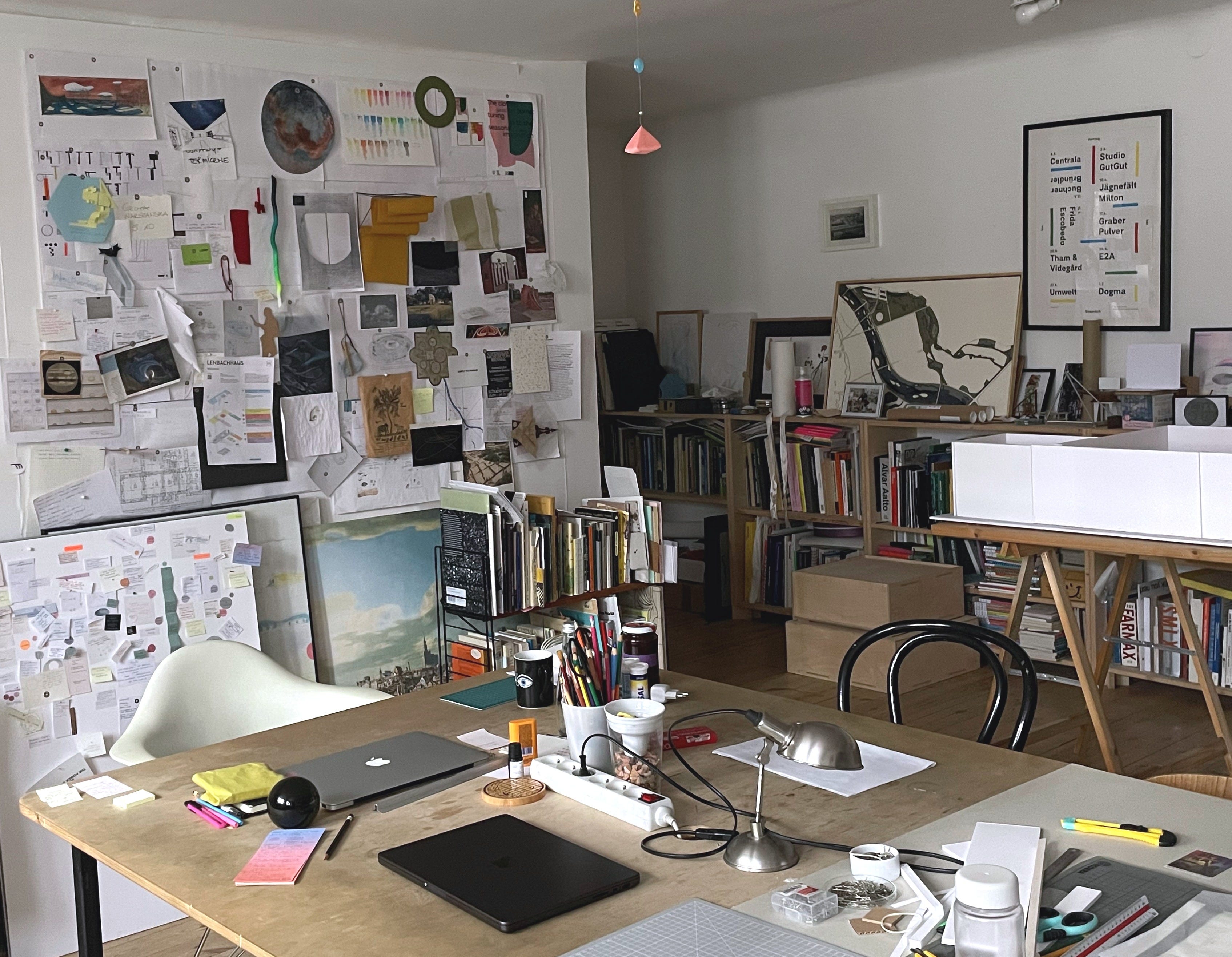
“When do you take a project down?” I asked as politely as I could. Despite my courteous tone, they both seemed confused and a little taken aback. They didn’t understand what I meant. I tried again. “What are your current projects? Who commissioned them? What is the brief?” I waffled on a little nervously, trying to find a way in. Małgorzata and Simone were quiet for a moment.
“Let me explain our process,” Simone said.
Our process. Not our outcomes. Not our successful, completed projects.
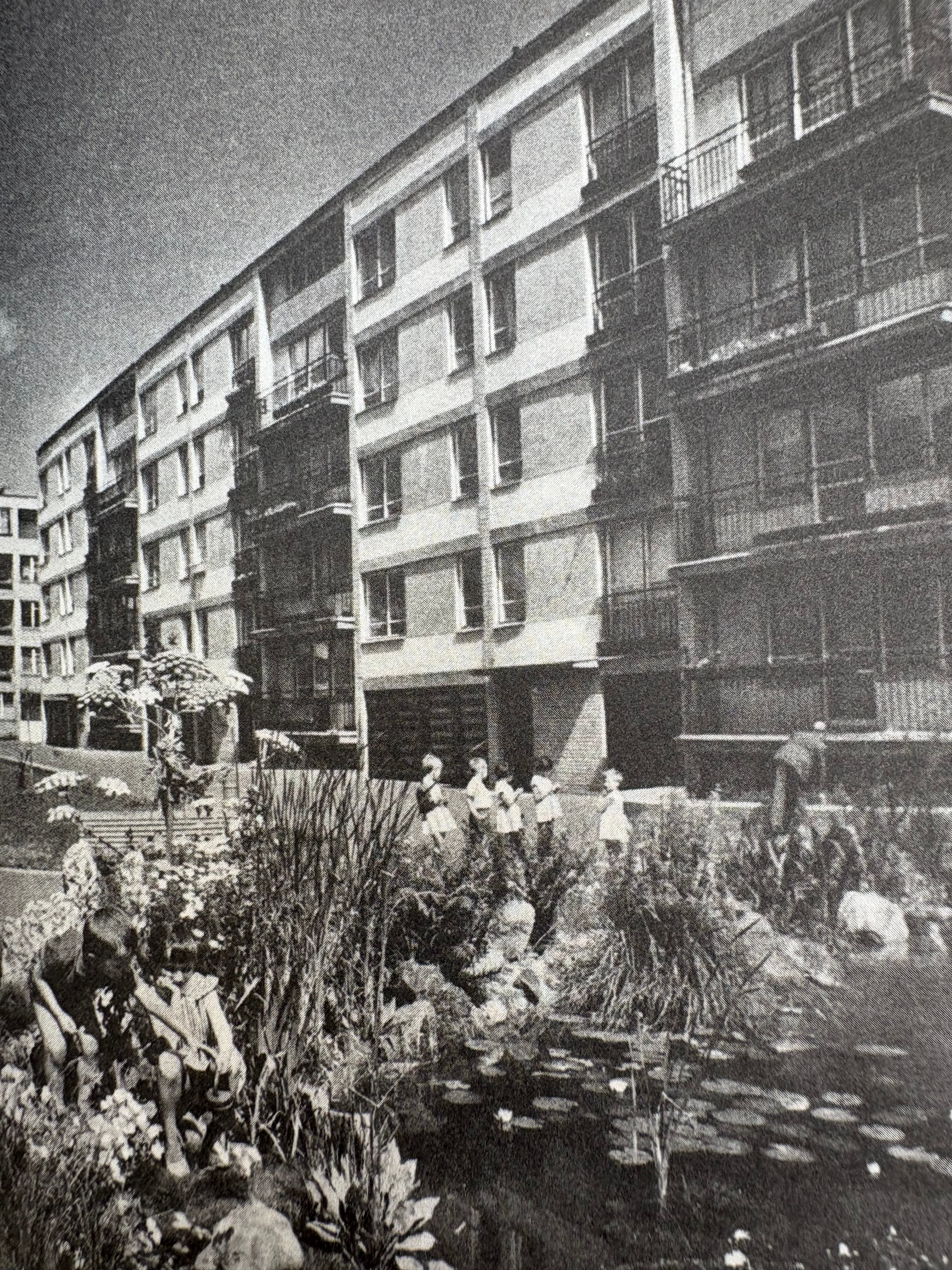
Małgorzata went on to explain that earlier in their careers they had felt boxed in as architects—winning a client, getting briefs, being in that tight matrix. She pointed to a photo of lily pads pinned to the wall. Several years ago, they’d become fascinated by a single photograph: a concrete pot with aquatic plants in it from a 1980s book called Urban Aesthetics. They dug deeper and found that lily ponds were once a common element of Polish architecture. They wondered: Why? And where had they all gone over the past 30 years?
I felt the energy shift between us. I know what it’s like to get obsessed with a question like this. Your mind can’t put it down.
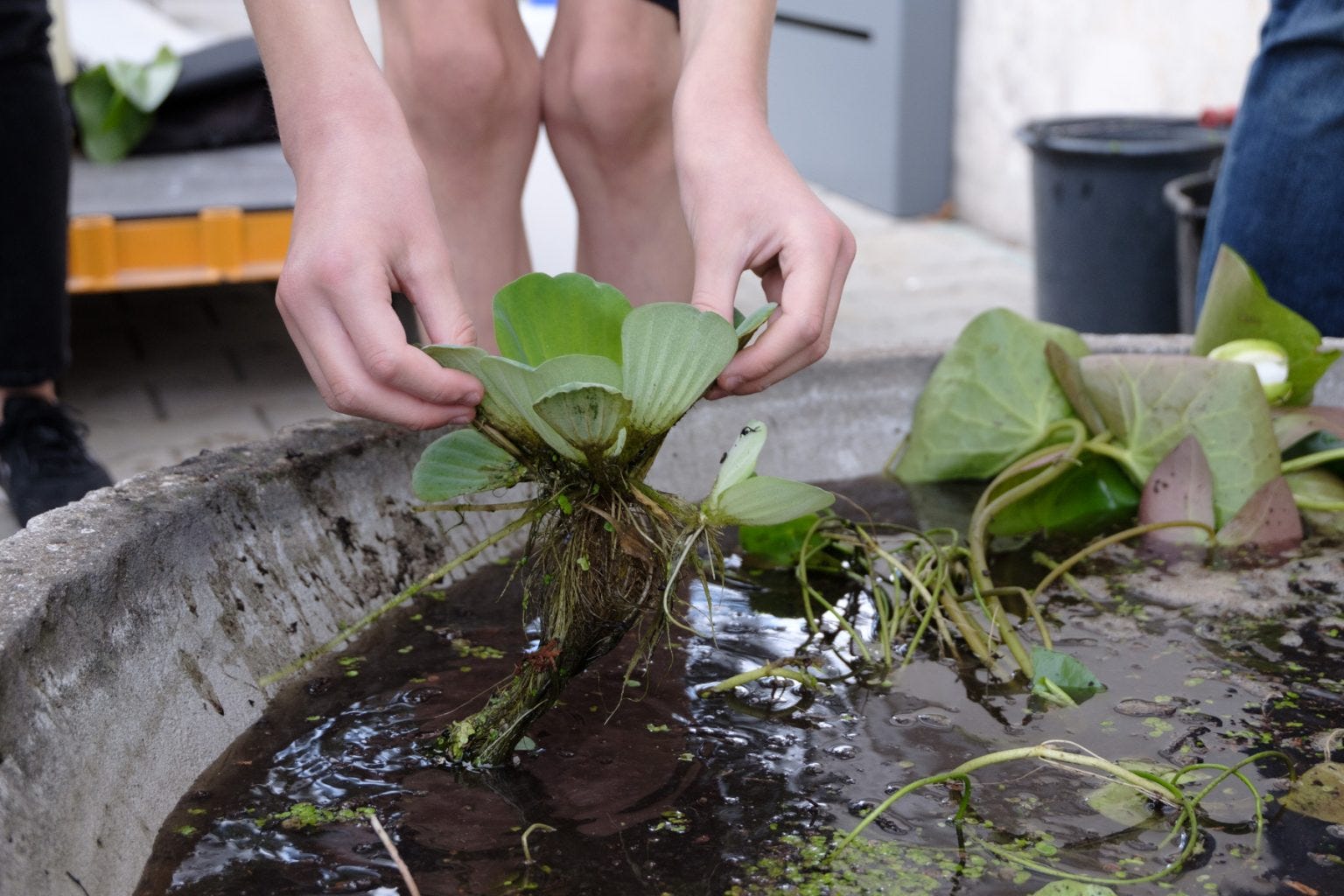
The pair became consumed with bringing the lily ponds back. They started collecting photographs that proved Modernist architecture had originally been accompanied by natural ponds filled with aquatic plants, not necessarily the sterile reflection pools commonly seen today. They researched, in great depth, all kinds of species such as the water moss, water cabbage, and water caltrop. They found countless details and data—how to weed the ponds, what to grow in tandem, which plants produce fruit that could be eaten or dried to make jewelry. All information was valid, all lines of inquiry given care and attention.
Małgorzata explained that when she and Simone become deeply fascinated with something, they just study it and trust that it will grow into what they call “work threads” meaning the topic will not only find connections to other projects but also a home in the outside world. Inevitably, because they spend so long immersing themselves, word spreads about whatever topic they’re researching and, instead of pitching, clients who are already attuned to their work reach out to inquire. They have successfully escaped the suffocating cycle of pitching and delivery, pitching and delivery—all by following their own curiosity.
I was struck by the biases I’d brought through the door with me—a huge, invisible bunch of brightly coloured balloons, taking up all of the space in my mind (and in the room). I had defaulted, as I always do, to viewing things with a commercial lens. When it wasn’t immediately clear to me what the financial incentive was, I couldn’t make sense of the work.
I realized, like a punch to the stomach, how much of my life has been lived to a brief.
Every speech. Every book. Every course. Every creative project. Even when I’ve stumbled across an interesting idea before the brief arrived, I have been quick to make it make sense, to find it a home, to find a justification for it.
And yet, for the last couple of years, I’ve been feeling the overwhelming urge to linger with certain ideas or historical figures, to follow my own threads from one person to another, across decades, across continents, to trust that following my curiosity is, in fact, an excellent use of my time. I have indulged that urge, but with a certain amount of shame and self-consciousness. But there in Centrala’s studio, I received the message loud and clear: in order to do my best work, I had to find ways of breaking free from creating to a brief.
But how am I—how are any of us—able to do so, both emotionally and practically?
As I continued my week of immersion and met with more inspiring designers, these three things emerged:
Courage. It’s deeply courageous to commit your time and energy to something without knowing the angle or what will happen, either creatively or financially. It takes bravery to go into places that don’t make sense, at least not at first—to open doors and peer inside even if you don’t feel like you fit in, or have any right to be there. To ask questions—and more questions—with no end goal in sight.
Resistance. It’s all too easy to be pulled back into familiar work—by your discomfort, by habit, or by other people who stand to make money off of your output. You will, of course, have to concede to it from time to time—we all have to square a financial reality—and it will undoubtedly take a couple of weeks, sometimes longer, to get back into your discovery mindset. But you will get back. Trust that you can.
Time. I used to be proud of how quickly I could churn projects out—the faster I was working, the better I felt. Now I understand that the slowness of the process is incredibly valuable and necessary, especially in distinction from AI-produced content. Working without a brief requires connection to people, materials, and place. It takes a long time to join those dots. It demands getting away from your desk and diving into field work. It requires getting lost. That is really hard to accept, but once you do, completely freeing.
I hope you can find a space in your life to create without a brief. Maybe it’s starting a project at home with no end goal—planting a single plant, then another, then another with no garden plan. Or maybe it’s creating a pinboard with just a single word or image and letting your inspiration unspool from there.
Whatever it is, I’d love to hear about it in the comments.
I love this piece. I plant word gardens. Sometimes a word just captivates me and I want to know its root and it begins, like the tape you mention, to connect to ideas and then other ideas. Like text and textile, and I read something about textiles and threads and thought about how texts are threads and connect in different ways--crosshatching, tied at the ends, braided together. . . like ideas often come together, the relevance in one setting, however different, somehow isomorphically related in another setting or environment.
The idea resonates deeply as i find myself approaching 50 and thinking what am i going to do with the rest of my life. Call it midlife crisis or maybe some modern version of it when 50 is the new 40 or something.
But I find myself with some means, experience and energy to do something exciting, and it's incredibly difficult not to think of which "brief" i should espouse. Much like most people don't think of what kind of clothes i should buy, but mostly find some fit with whatever is in the store racks. Mostly.
Some people are quite creative with food, but most go in their heads through a catalogue of dishes they've eaten before.
Maybe it's a big leap but, they are all versions of "briefs", recipes, templates.
It's scary to face a new phase of life in such and adventurous fashion, letting myself be drawn by curiosity or infatuation, and trust it will lead somewhere.
Maybe its healthier to start with a new plant at home as you suggest, and see where that takes us.